THIS IS NOT AN ELSEWHERE
A conversation on SKINFOLD between ANDREA RODRIGO, MAR* SZYDŁOWSKA & ABIGAIL ALEKSANDER
THE CHOREOGRAPHIC AND THE FELT SENSE
Andrea Rodrigo: How did you approach working on SKINFOLD?
Mar* Szydłowska: We started working on SKINFOLD primarily as practices in the studio, researching questions around queer phenomenology and body dysphoria. We didn’t know each other well, we bonded one day, when I asked Abi to show me how to tape my chest. This was happening in the context of dance education, where physical representation is under a lot of pressure and additionally we had our own questions coming from mundane experiences of inhabiting a body as queers. We wanted to work on coping strategies for this felt sense of the body. We were initially interested to share this research through studio hangouts with other queer identifying people, we still are, but somehow, along the way, it also became a choreographic work.
AR: How do you understand the choreographic in this work?
MS: The felt sense was crucial from the beginning: it pointed to the direction the practices could take, but also to understanding how to approach this as choreography while reflecting from a phenomenological perspective. There was movement between the question of a body's representation and identity, and what is happening in its felt sense. The practices came from hours of exploration fueled by questions, a place of formulating a language. A body language. And once we started to observe it, we could see its choreographic potential. I like to think about choreography as something that emerges, reveals itself, not something that is being decided upon and structured.
Abigail Aleksander: When I think about the choreographic, I think about the work we did to sustain these languages that emerged. Not all the materials were pleasant to work with. Some were downright confronting, dysphoric — we were dissociating. But we stayed with it because we felt it was important for the work. Melina Stinson, the intimacy coordinator, was incredibly helpful with this. She helped us recognise dissociation as a perfectly valid strategy that is part of the process.
STAYING PRESENT WITH DISSOCIATION
AR: Dissociation is a potent dynamic within queer experience. Maxi Wallenhorst (Like a Real Veil, Like a Bad Analogy: Dissociative Style and Trans Aesthetics, 2024) writes about dissociation as an archive of not feeling it. The moment in which feeling doesn’t feel like feeling—a state that invokes feeling intensely and feeling intensely detached.
MS: One practice emerged from a text by Kathy Acker on bodybuilding, where she describes the relation between language, naming, and the body itself—trying to say that body is a language of its own. She asks: what if a body is a foreign land to me? What if it is something not accountable? Allowing yourself to become alienated from the body while staying with the feeling of alienation—that was something we worked on for hours.
AA: Yes. There were questions of body ownership, trying to get comfortable, trying to feel at home.
MS: Both dissociation and dysphoria involve experiences of bodily fragmentation, or sometimes its troubling absence. The choreography emerged from working directly with these sensations. This is where Monique Wittig’s The Lesbian Body (1973) comes into play because of the specificity of this text, where the body is chopped over and over again through language and desire. For me, it heightens the affective part of our work, the desire to be seen and the urge to disappear; a desire that is not only erotic, but also has to do with self-recognition. One of my favourites in the book is a description of a lover’s separated body parts being found and collected on the beach —an eyeball, an ear lobe, a hand... When I perform SKINFOLD, I feel my body parts are dispersed everywhere in the space.
AA: She was clarifying processes to find different ways to talk about the body. The way she goes under the skin—lifting the layers, pulling apart the tendons. This resonated with the imagination we were using to think differently about the layers of anatomy. She writes about everything equally—the vulva, the chin, the buttocks, the kneecaps. Everything is equal, everything is erotic. Which is freeing because it’s not hierarchical.
MS: Wittig activates a very uncompromising process that doesn’t remain in the layer of representation or image. If you look at how the external gaze and voyeurism operates, how the so-called “male gaze” fragments bodies (Laura Mulvey, Visual Pleasure and Narrative Cinema, 1975)—and then you look at Wittig’s fragmentation, there’s a strong shift. There’s agency in the fragmentation that goes deep into the flesh, that is relational, not distant. When we address Wittig to the audience, we are interested in shifting this power dynamic from the external observer to a shared corporeality.
POLITICS OF THE GAZE
AR: Were the dramaturgical decisions made based on the relationship you were already having with each other?
MS: We watched each other a lot in the first moments of the process. To be seen and seeing each other was a form of support, despite the fact that we were new to each other and we had to overcome many discomforts of sharing something we felt as intimate. If we look, it brings into the room another entity: the looking itself.
AR: This study of the gaze was already happening amongst you, and then it informed the politics of the audience's gaze?
MS: Yes, what emerged was a study of the availability for the gaze. We were interested in setting a frame, in which looking shifts its meaning, potential, and is an active force we engage with through choreography.
DURATION AND THE PERCEPTION OF TIME
AA: People say it’s slow. But it’s not slow—it’s just time. We’re tuning in, hanging out, sharing space. MS: Duration relates to attention and how it moves through space. I find it very relevant, it allows for the complexity of seeing and sensing.
AA: Some things reveal themselves through accumulation—a constant digging in a certain direction. It’s funny because I actually have a really short attention span and find it challenging to focus on one thing for long. I guess for me there is a tension with attention. But within this stretched out time, these twisted body contortions, there is also a strange comfort, its rather peaceful being a landscape.
AR: Is the duration for the audience or for you?
MS: Duration allows the reading of the work. Apart from the fact that I truly enjoy performing for hours…
AA: The work is exactly as long as it needs to be for the perception shift to happen. It needs time for settling, arriving, getting bored and coming back. To get all your assumptions out.
SOUND
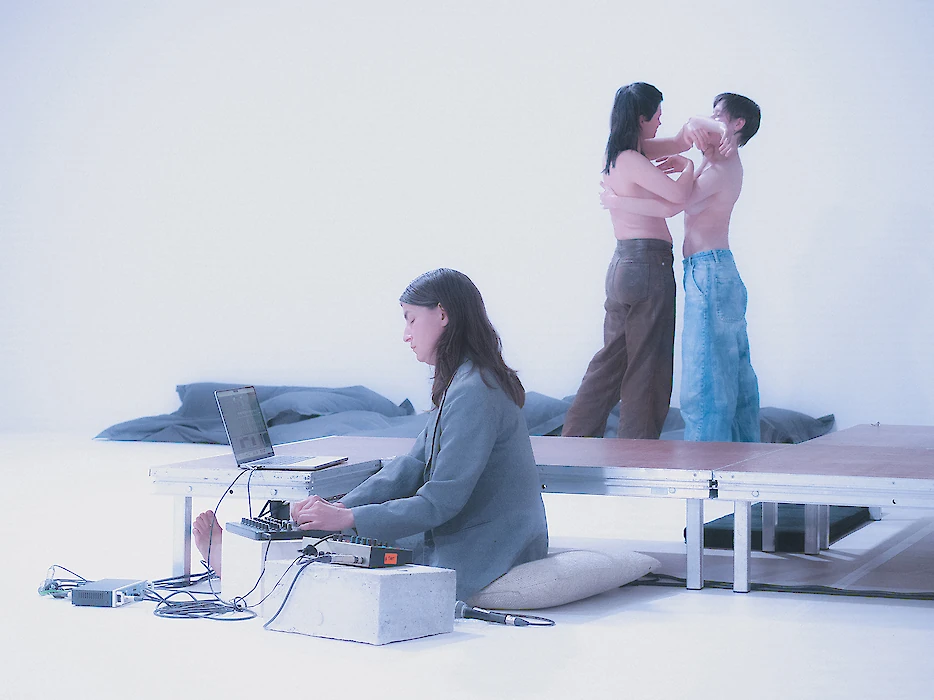
AR: The sound is mixed live by Hannah Todt, her presence and sensibility create a specific curve of attention.
AA: The sound helps with the insisting. It’s like a net of continuity. It’s not a counter melody—it’s really going with, holding, filling the air, filling the space that can’t be filled otherwise. Hannah did an awesome job running with that description: helping us hold what is happening. The team—Amina Szecsödy, the dramaturge, Hannah Todt, and Melina Stinson—really supported how much effort and attention this work takes. The way the dramaturgy, the sound, and the intimacy coordination were brought in was really about how to support and hold together. We always say: we’re three performers. Anyway, Hannah is the real star of the show, we are just her backup dancers.
ECOLOGY OF ATTENTION
MS: There's a distinction between an economy of attention—time as capital: pay attention—and an ecology of attention, a reorientation of our relation to time and intentionality (Yves Citton, The Ecology of Attention, 2017). SKINFOLD plays with this idea of attention ecologies. This definitely intends to be against capitalist rule. There is a sociality that the work generates. A longing for social relations that can emerge from being together in space at this level of vulnerability, looking across at each other, staying close to the ground.
AA: The door stays open so people can come in and out—a reminder of what is energetically happening, that this is not an imaginary world, not an elsewhere. The open door is a representation of: this is something that happens in this world, not in another world. It needs to happen here.
AR: That’s also why you don't need the sacredness of the theatrical dispositif—and why the way perception is structured in the theater is rejected. The decisions and punctuations of space you've made are a condition for producing a certain experience that would be difficult with the tiered seating of the theater.
AA: Yes. It matters that the audience, our witnesses, sit at the same level, not looking down. That there’s a wash of light so they’re not hidden in the dark—they can be watched too. Held accountable for their presence. This forms sociality. These decisions—the lights, the setup, the open door—are conditions for producing a certain experience, both in us and in the audience. It would be a completely different work without these conditions. The work takes everyone along.
MS: It is about flexing, stretching, allowing it to last. It’s important to give time so the piece does its work—to transform into a space and zone which operates differently than the mode people enter with.
AR: So perhaps we can ask the audience at Beursschouwburg. What is the sociality they can sense through this work? What does it mean to let the world turn into something beautifully unknown?
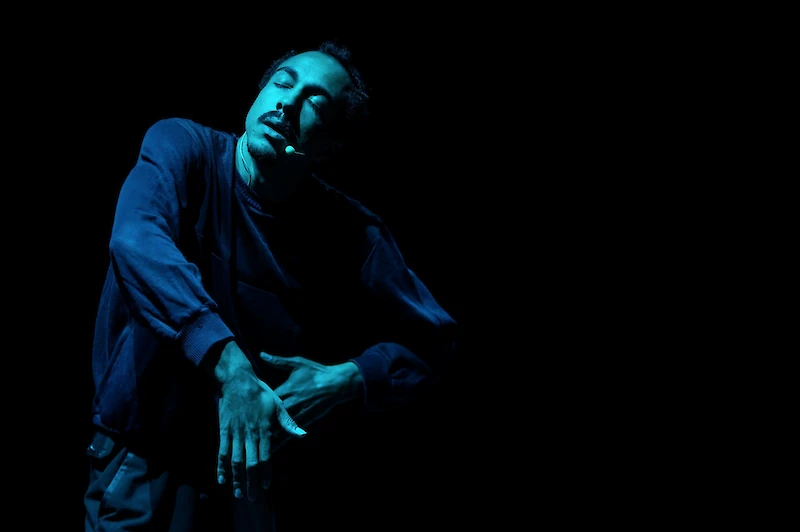
image ©Paola Lesslhumer