IS THERE STILL HOPE IN THE CAPITAL?
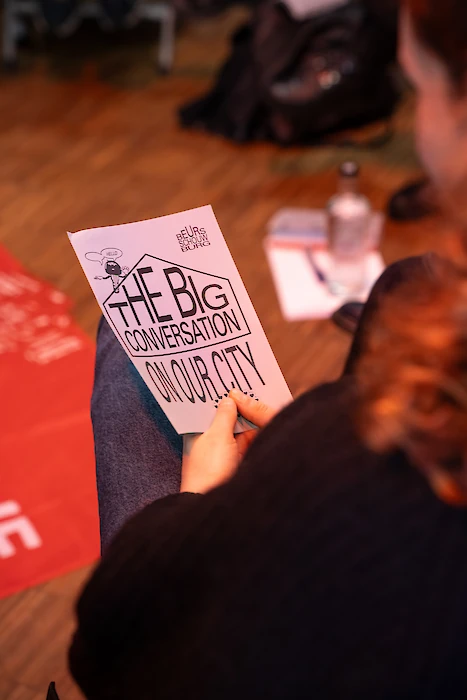
Under the motto “Our House In The Middle of Our Street,” the Beursschouwburg invited 13 different creators, dreamers, and residents to reflect with its audience on our city. During The Big Conversation on Our City on January 31, around a hundred Brussels residents came together to imagine a kinder, bigger, and better city.
“Aujourd’hui we’re doing it op zijn Brussels,” geographer and one of the day’s moderators Mae de Monchy sets the tone from the first sentence. Dancing between three languages, they don’t hold back: “This is day 601 without a Brussels government. It’s hard to keep our chests together. We may be subversive, but we are also rich and diverse.”
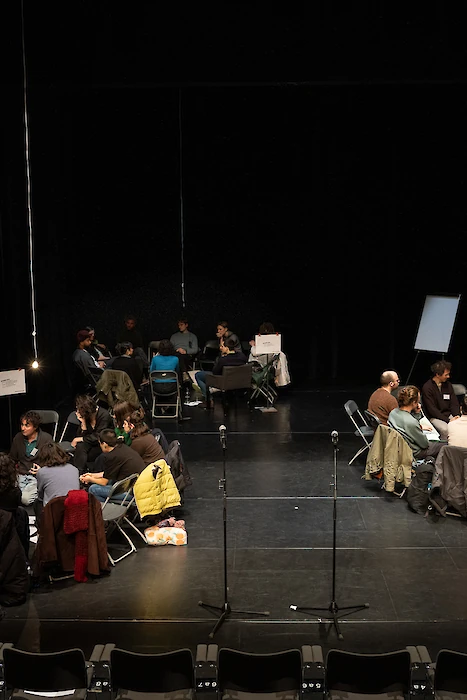
The audience nods along. People are eager, hungry for something to soften the bitter pill of over 600 days of government formation, suddenly closed cultural spaces, police evictions of squats where families live, a growing homelessness crisis, and not to mention the alarming drug-related violence in some neighborhoods. The day is divided into three rounds, with nine speakers taking place in different areas of the building each time. Each discussion session can host around ten people, who then engage in conversation for forty-five minutes. There is no fixed route, no narrative to follow, no pattern. Just like in the streets outside, every choice brings your intentions into focus.
WILD IMAGINATION
Among the cushions of the quiet space, researcher Tasneem Nagi asks us: how do boundaries appear in our lives? How do we make a home? Where and with whom? Tenderness radiates. Gently, she confronts us with how the external borders of this country and continent also draw lines through the city — from Frontex controls at the South Station to separate queues at the municipal offices.
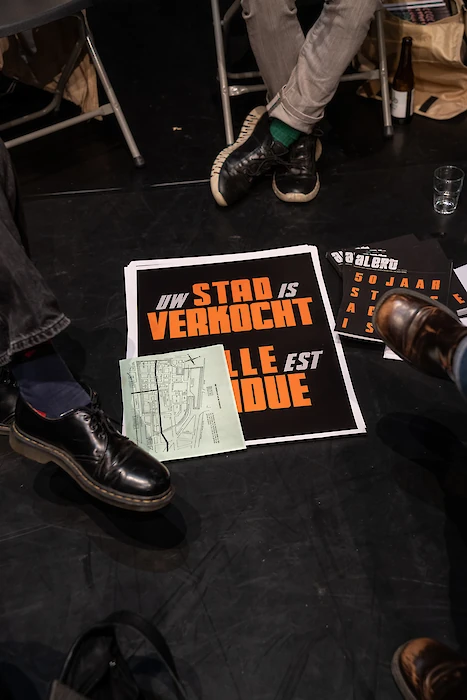
With Pepijn Kennis, the group reflects on how to achieve more affordable housing. Plenty is being built. The flashy flyers from developers in the center of the circle show only the dreams of capital. Kennis explains how projects like the real-estate cooperative Fair Ground Brussels can also breathe life into the real needs of ordinary Brussels residents.
A little further on, Bie Vancraeynest of Toestand vzw appeals to the imagination of the participants. The room is darkened, essential oils and scented candles fill the air with a blend of eucalyptus, tulsi, and patchouli. “Wellness should be for everyone,” she tells her audience. The central question of the day: what if the Bourse were a public bath?
UNREADABLE DESIRES
And so it goes. Appoline Vranken asks how we can blur the boundaries between public and private spaces, to also challenge the distinction between traditionally “male” and “female” spaces. Jozef Wouters wonders why gates suddenly appear where open public space was intended: “In the dance world, we call that a half-gesture,” he explains. “It has an unreadable desire.”
There is too much to see and follow everything. In the meantime, poets Kübra Avci and Zaïneb Hamdi lift our language. A Big Conversation requires grand verses. Fragile idealism in a tough city cannot survive without being transformed into art.
Among the audience are also numerous students and PhD candidates. Charlotte is one of them; she researches various squats and temporary occupations where people without residence permits and/or a roof above their heads create a home together. “Through drawings, I map how they transform the buildings where they live.” She collaborates with one of the thirteen speakers of the day: Saïd El Louizi from Zone Neutre and La Voix des Sans-Papiers. Not the most hopeful work, it might seem, until you hear Saïd’s explanation.
WHAT A BOUNCY CASTLE CAN DO
In the center of the circle lies a large white poster printed with a timeline. It details and explains all the different temporary occupations and squats over the years. Arrows trace the movements of Brussels’ undocumented residents through the city — from an old office building to a vacant administrative center and beyond. Through his story of superhuman perseverance at our feet, El Louizi describes how difficult and traumatic the last eviction was for his collective. But he also sheds light on how they have begun again elsewhere.
El Louizi explains how challenging it can be when petitions demand the evacuation of a squat, but also how successfully they can change people’s minds. “Every place we settle in changes the neighbors’ opinions. You wouldn’t believe how often people told me they were initially against us, even calling the police to have us removed — only to change their minds once they visited and talked to us,” Saïd El Louizi recounts. “During our previous occupation, we were able to organize a neighborhood party for children both in the collective and in the area. What a bouncy castle can do for a community, right?”
The day flies by. Before we know it, it’s time to hit the streets again. One last dream — or nightmare — for Brussels? Participant Joachim keeps it simple: “I have only one dream for our city. That one day all the construction work will be finished and all sites completed.” As with everything in Brussels, even that answer cannot fully stand. According to audience member Kostas, perfection might even hide an end: “The beauty of Brussels is precisely that it’s always in motion, that everything can still change. We cannot let go of that.” Something to think about next time those cursed yellow-and-blue barricades reappear on the streets.
REPORTING
by Heleen Debeuckelaere
PHOTOS
by Miles Fischler