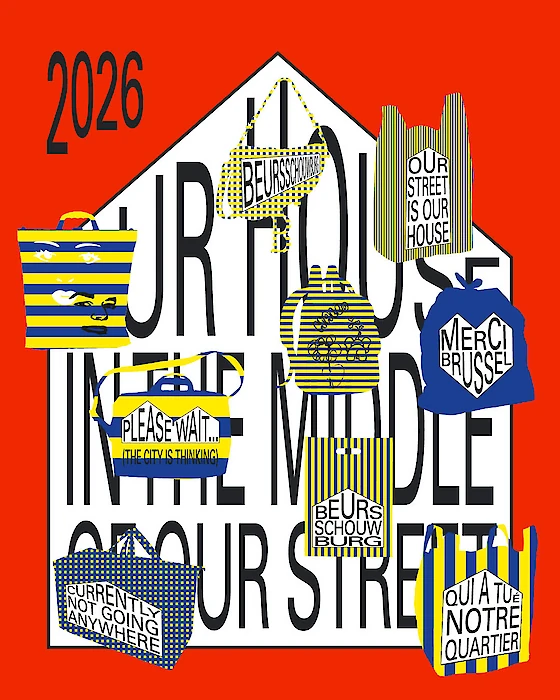
OUR HOUSE, IN THE MIDDLE OF OUR STREET
a focus on movement, standstill, and finding a place in the city
With a temporary move on the horizon, Beursschouwburg finds itself thinking about movement.
About moving from one building to another, and about all the ways in which people, ideas, histories and desires move through Brussels. About how movement is not equally distributed. Some people cross borders, neighbourhoods and social spheres with ease. Others spend years waiting for papers, a home, a permit, a metro line, or a future that never seems to arrive.
This autumn, we look closely at a city caught between motion and standstill. At the endless construction sites around Stalingrad. At the debates over cars, pedestrian zones, and public space. At the canal that cuts through Brussels while connecting its neighbourhoods. At the people who arrive, depart, stay put, get displaced, or keep finding new ways through.
Who gets to move freely through the city? Who is expected to adapt? Who gets left behind? And what happens when standing still becomes a political condition rather than a personal choice?
For one year, we follow artists, neighbours, drivers, flâneurs, cyclists, migrants, and dreamers as they navigate the landscapes around us. We move through parking garages and palaces, through artistic careers and language systems, through histories of exile and futures yet to be imagined. We take detours through the city and linger in places where movement slows down.
As we prepare to leave our building for a while, we pay attention to everything already in motion outside our doors.
Because a city is not defined by its monuments or masterplans. A city is made by the people moving through it.
And by those who insist on staying.
spring OUR HOUSE, IN THE MIDDLE OF OUR STREET 2026
a focus on our city, streets without borders & breaking up with a building
We’ll be here a little while longer, but with renovations planned for 2027, we’ll be moving out for a time. While searching for a temporary home, we found ourselves — once again — in a city full of empty spaces. Beer museums and community centres, open-air pools and pop-up studios: audiences and places keep missing each other.
That’s why, in 2026, we turn outward. Toward a pedestrian zone that began as a picnic. Toward les cinq blocs and their slow decay. Toward Sint-Katelijneplein, crowded with terraces and stripped of benches. Toward the steps of the Beurs, a site of resistance and connection.
Who gets to imagine the future of our city? Who are the (project) developers shaping our neighbourhoods? And which centre will we return to once the renovations are done?
For one year, we rehearse saying goodbye to a building by letting the city move in. We look in on our neighbours — long-time and newly arrived Brussels residents, squatters and artists, undocumented migrants and the punks who look out for them. We hold big conversations and sing little sidewalk songs. We celebrate sound systems and trap roulettes. We study police violence and public pleasure. We watch children play outside and bodies dance in silence. We cherish territorial cinema and a people’s parade.
So welcome to our home. Step into our street.
It’s here for you too.