

Moving Along
Hoe heeft de auto onze manier van samenleven veranderd? En wat gebeurt er als mobiliteit zelf het organiserende principe van de stad wordt?
Je kan zo vaak als je wilt komen kijken, en dit zelfs combineren met:
FRI 18.09 - BLOCK 4
SAT 19.09 - BLOCK 2 + BLOCK 3
SUN 20.09 - BLOCK 1 + BLOCK 5 + BLOCK 2 + BLOCK 3
WED 23.09 - BLOCK 4 + BLOCK 1 + BLOCK 5 + BLOCK 2 + masterclass w/ SoundImageCulture (SIC)
Deborah Stratman — The Stumble as a Map >>
THU 24.09 - BLOCK 3 + BLOCK 4 + BLOCK 2 + BLOCK 5 + BLOCK 1
FRI 25.09 - BLOCK 2 + BLOCK 3 + BLOCK 4 + screening + aftertalk
Kumail Syed — Les enfants ont des oreilles >>
SAT 26.09 - BLOCK 1 + BLOCK 5
over
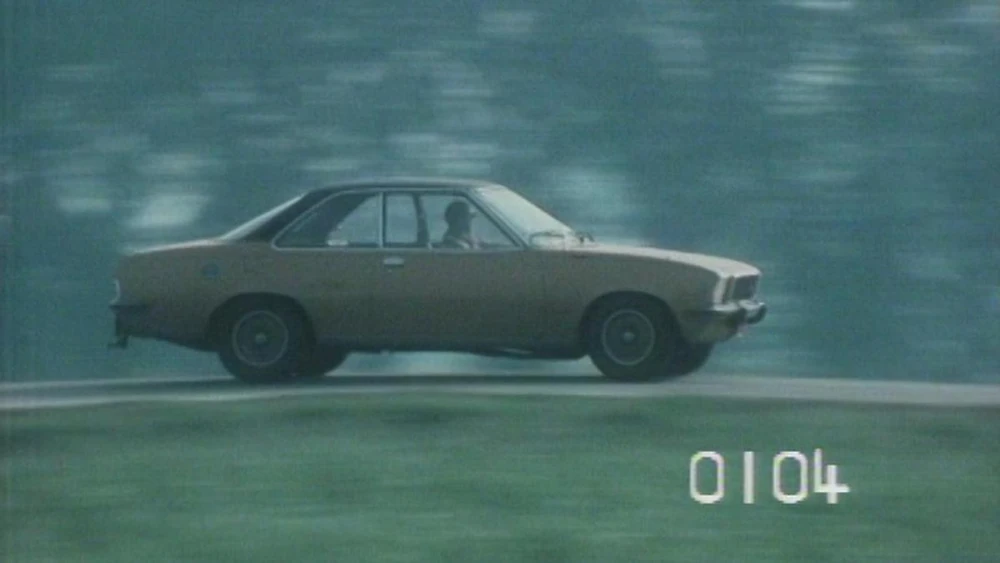
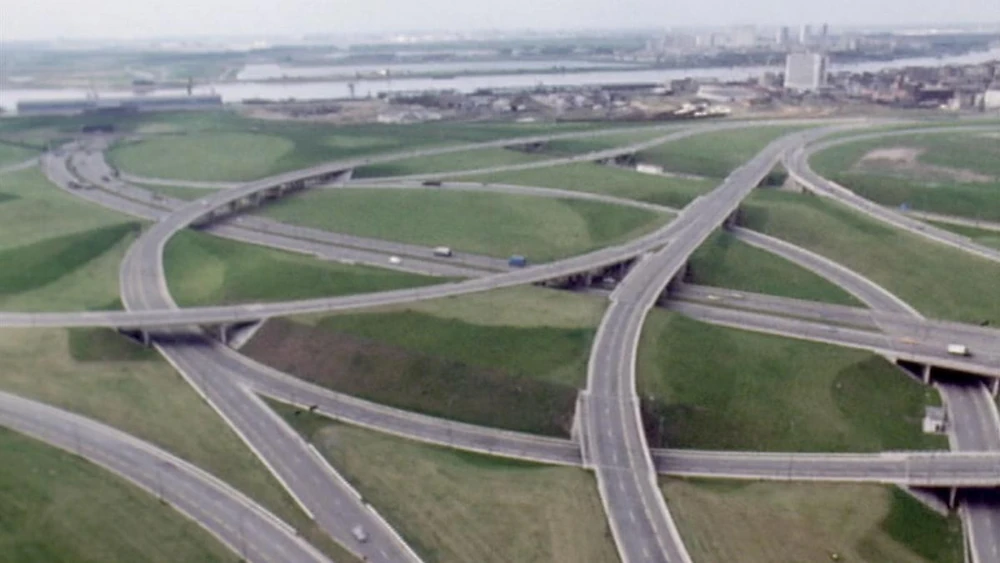
This fall, the Beursschouwburg film programme looks at the ways cars, trains, metros and other forms of transportation have transformed our daily lives and reshaped the environments around us. From the arrival of the automobile as a mass consumer product to the construction of motorways, parking lots and vast infrastructures designed to keep us moving, transportation has profoundly altered the scale, rhythm and appearance of our cities.
The films in the programme observe these changes from different perspectives. They look at traffic and congestion, but also at labour, leisure, architecture, and the simple act of walking. They ask who our cities are designed for, who gets to move freely, and what happens to the people and places that get in the way.
The programme also understands mobility in its broader social sense: as social mobility, moving between neighbourhoods, milieus and social classes, while encountering, negotiating and acknowledging the social and symbolic boundaries that surround us.
Sometimes critical, sometimes playful or absurd, these films invite us to look again at the seemingly ordinary systems that organise how we move through the world.
programma
1 — The BLVD - Deborah Stratman, 1999, 64min
An experimental documentary about the street drag racing scene on Chicago’s near West Side. This is a rambling, textured film about obsession. It is about the mythos of speed for its own sake, and it is about waiting. While waiting, The BLVD exposes community, inner-city landscapes and nomadic experiences of place. The film treats storytelling as a living medium for determining history. And it commands respect for those who transform cars, or anything else, through passion.
2 — NO ICE + De Straat + Rijksweg N1
Three films that look at the ways architecture and infrastructure shape everyday life.
Total duration: 100 min
With no ice, artist duo Denicolai & Provoost tackle the regulation of public space in the style of Jacques Tati. De Straat & Rijksweg N1 on the other hand were made by Jef Cornelis in collaboration with architecture critic Geert Bekaert, examining architecture and urban planning not simply as matters of design, but as forces that organise how we inhabit and move through the city and public space.
NO ICE - Denicolai & Provoost, 2002
Your favourite Brussels artist duo tackle the regulation of public space by having eight ice cream vans perform a guerillia ballet at a strategic roundabout (that is currently and notoriously under construction!) creating a s-creaming sound effect announcing the small pleasures of summer city life.
De Straat [The Street] - Jef Cornelis, 1972, 42min, ENG spoken
“Of the street not much is left but a traffic road – a movement machine, as Le Corbusier described it [...] The habitable space of the city, the street, has degenerated into a pure locus for traffic.”
Rijksweg N1 - Jef Cornelis, 1978, 43min, NL spoken, ENG subtitles
De weg tussen Antwerpen en Mechelen was de eerste nationale weg in België en wordt in de film exemplarisch voor de impact van het gemotoriseerde verkeer op de leefomgeving. Rijksweg nr. 1 brengt weliswaar de steriliteit van het leven langs een drukke weg in beeld, maar laat niettemin zien dat de mensen er voortleven alsof er niets aan de hand is.
3 — Kid Auto Races at Venice + Trafic
Two comedies about bodies caught in the machinery of modern mobility. Chaplin and Tati turn traffic and transportation into stages for a struggle between the systems we build to keep things moving and the unpredictable people who inhabit them.
Total duration: 102min
Kid Auto Races at Venice
Henry Lehrman, 1914, 6min
Charlie Chaplin’s character Little Tramp repeatedly disrupts the carefully organised spectacle of the car race, getting in the way of cameras, crowds and automobiles.
Trafic
Jacques Tati, 1971, 96min, FR+NL+ENG spoken, ENG subtitles
Monsieur Hulot is working on a revolutionary camping car that he must bring to an international automobile exhibition in Amsterdam. Along the way, he encounters traffic jams, breakdowns, bureaucracy and countless unexpected obstacles that continually delay his journey. Despite all the setbacks, Hulot remains cheerful, while the chaos around him only continues to grow.
4 — Metropolis
Approaching public transport as a space of movement, observation, and encounter, these films shift attention to the people who inhabit these mass transport systems: reading, travelling, observing, working and moving through the city at different times and speeds.
Total duration: 104min
Would You Like to Meet Your Neighbor? A New York City Subway Tape - Barbara Hammer, 1985, 13min, ENG spoken
Barbara Hammer (wearing a mask and suit made of subway maps) investigates what subway passengers are reading, what are their thoughts on the city, their fellow passengers, and navigating public space.
Schwebebahn - Arianne Olthaar, 2016, 4min, no dialogue
A suspended railway ride by night.
Ghost Tropic - Bas Devos, 2019, 85min, ENG subtitles
After missing the last metro home, Khadija begins a long journey on foot through Brussels at night. Along the way, she encounters people who, like her, are moving through the city outside its usual rhythms.
5 — Rangierer + Avec le sang des autres
From the railway yard to the factory town, movement becomes inseparable from labour, and labour from the structures that organise society.
Total duration: 74min
Rangierer
Jürgen Böttcher, 1984, 22min
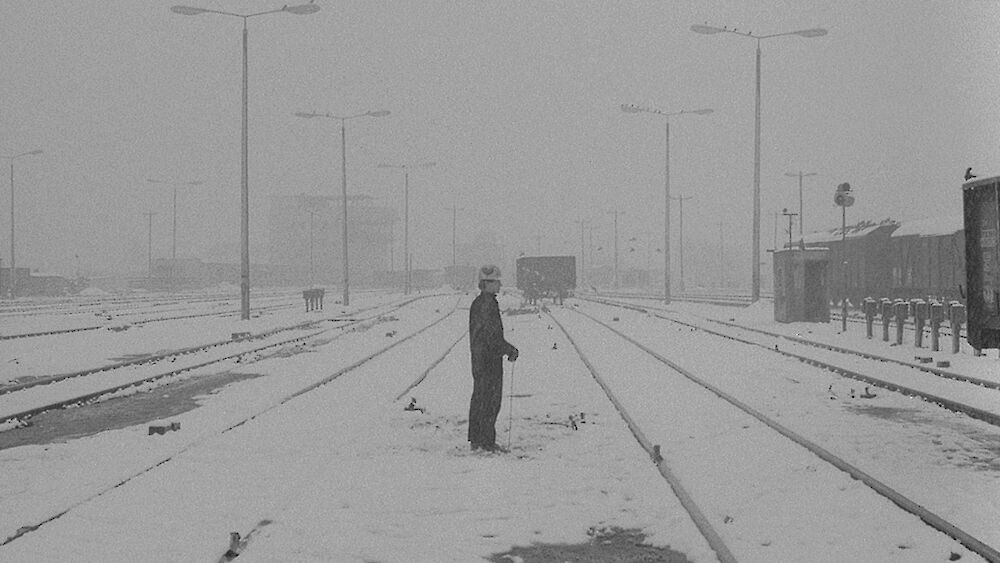
Rangierer shows the shunters working at the Dresden-Friedrichstadt freight yard. The railway workers of the Ablaufberg collective marshal, brake, uncouple and couple the freight cars – around 1,600 wagons during a single shift. Working the night shifts, in snow, ice and fog, is particularly demanding for the men. The painstaking and exhausting work of the switchmen at Dresden-Friedrichstadt station, day an night, in all weathers. The film stylises the men's dignity, the violence of work, the night's chill, the lamps, the fog and snow, without emptying them of their substance or breath. There is no commentary, and the only words are those uttered by the men at work.
Avec le sang des autres
Bruno Muel, Groupe Medvedkine de Sochaux, 1974, 52min
"Een afdaling naar de hel. De lopende band bij Peugeot – een oorverdovend beeld. Dit is de kern van het Peugeot-imperium: de meedogenloze uitbuiting van menselijke arbeid. En daar blijft het niet bij: winkels, supermarkten, bussen, amusement, vakanties, huisvesting, de stad zelf – het maakt allemaal deel uit van het Peugeot-landschap. Terwijl we het circuit volgen, valt alles terug te voeren op de familie Peugeot."

